
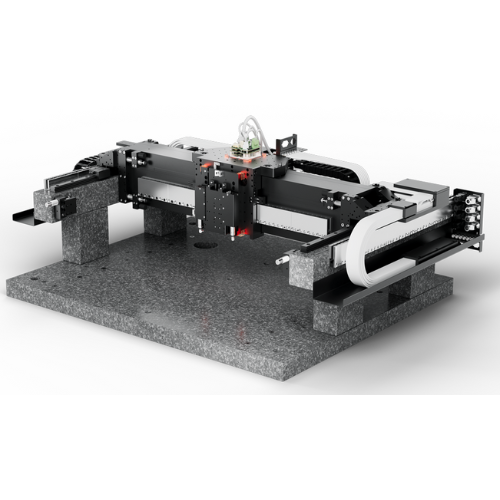
High‑precision gantry stages are the backbone of modern semiconductor, electronics, and advanced manufacturing systems. As machine builders push for higher speeds, tighter tolerances, and more consistent results, traditional single‑axis and loosely coupled control strategies start to reveal their limits. Mechanical imperfections, cross‑axis disturbances, yaw errors, and dynamic loads all create performance barriers that cannot be fully solved with traditional tuning alone.
ACS addresses these challenges through advanced multi‑input multi‑output (MIMO) gantry control algorithms, designed specifically for high‑precision gantry architectures. These algorithms are a core part of Smarter Gantry Control technology and are powered by ACS’s multi‑axis servo processor architecture.
Why MIMO? The Limitations of Conventional Gantry Control
Traditional gantry control often relies on parallel single‑axis loops or MainDevice ‑ SubDevice architectures. While workable for basic motion, these methods struggle with:
- Axis‑to‑axis dynamic coupling
- Disturbances from one side exciting the other
- Mechanical compliance or yaw imperfections
- Performance consistency over large travel ranges
- Maintaining high bandwidth without risking instability
Even with advanced tuning, cross‑axis disturbances can degrade settling time, accuracy, and throughput — especially as payloads increase or the gantry structure becomes more flexible.
ACS’s MIMO Gantry Control: A Smarter Approach
ACS’s advanced MIMO algorithm directly addresses these issues by treating the gantry as a coupled multi‑axis system rather than independent linear motors. According to ACS’s controls team, Smarter Gantry Control is:
“Powered by unique, multi‑axis servo processor technology… advanced multi‑input multi‑output (MIMO) gantry control algorithms that simplify configuration and tuning while enhancing accuracy, throughput, and stability.”
This system‑level control strategy enables the controller to:
1. Increase Servo Bandwidth & Disturbance Rejection
MIMO control improves how the gantry responds to disturbances — including disturbances where motion on one axis induces error on the other axis.
This creates:
- Faster settling
- Lower position error
- Improved robustness across operating conditions
2. Maintain High Performance Regardless of Position
The MIMO algorithm provides “more consistent performance that doesn’t depend on stage axis positions,” especially important for large‑format gantry systems.
3. Enable Mechanical Error Compensation including:
- Dynamic cross‑axis compensation → higher throughput & accuracy à ability to sense influence or impact from another axis in a system and compensate accordingly to minimize overall system errors
- Dynamic error compensation → improved precision à ability to measure and compensate for inherent mechanical errors in real-time as motion systems move throughout their areas of work
This compensates for real‑world mechanical imperfections — yaw, compliance, load asymmetry — in real time.
4. Support a Wide Range of Gantry Architectures
The MIMO algorithm is designed for:
- Rigid & flexible‑yaw gantries
- Mechanical, air‑bearing, and hybrid gantry designs
5. Simplify Tuning with Advanced Tools
The MIMO solution is supported by the ACS FRF Analyzer, enabling:
- Rapid frequency response measurement
- Easier parameter optimization
- More efficient tuning & validation
Smarter Gantry Control in Advanced Applications include:
- Wafer inspection
- Laser processing & micro‑machining
- Electronics assembly & inspection
- Advanced packaging
- Precision metrology
These applications require:
- Sub‑micron and nanometer accuracy
- Tight cross‑axis synchronization
- High‑speed scanning motions
- Fast settle‑into‑tolerance moves
The Bottom Line: Higher Accuracy, Higher Throughput, Lower Effort
ACS’s Smarter Gantry Control with MIMO offers machine builders:
- Higher bandwidth & stability
- Better accuracy through dynamic compensation
- Faster cycle times due to improved disturbance rejection
- Simpler setup and tuning
- More consistent performance across the gantry workspace
By leveraging ACS’s multi‑axis servo processor and advanced control algorithms, OEMs can push their gantry performance to levels not achievable with traditional control approaches.